

Professional presentation matters in every industry, and mens embroidered work shirts have become essential tools for businesses seeking to establish credibility whilst maintaining practical functionality. These customised garments combine the durability required for demanding work environments with the polished appearance that reinforces brand identity. From construction sites to corporate offices, embroidered work shirts create a unified team appearance whilst serving as mobile advertisements for your business. The strategic placement of logos, employee names, and company details transforms standard workwear into professional assets that enhance customer trust and team cohesion.
The Evolution of Embroidered Workwear
Work shirts have undergone significant transformation over the decades, evolving from purely functional garments to sophisticated branding tools. The history of the men's work shirt reveals how embroidered designs have become integral to modern workwear fashion, shifting from simple identification purposes to comprehensive brand representation.
Today's mens embroidered work shirts reflect technological advances in both fabric manufacturing and embroidery techniques. Digital embroidery machines produce intricate designs with precision previously impossible through manual methods, whilst modern fabrics offer enhanced durability without sacrificing comfort. This convergence of technology and tradition has elevated work shirts from basic uniforms to professional statements.
Industry-Specific Applications
Different sectors require varying approaches to embroidered workwear. Construction professionals need robust fabrics with high-visibility elements, often featuring logos positioned for maximum visibility whilst maintaining safety compliance. Hospitality teams prioritise smart appearance with embroidery that conveys sophistication without overwhelming the garment's clean lines.
Healthcare workers require antimicrobial fabrics with subtle branding that maintains professional standards whilst ensuring easy laundering. Corporate environments favour crisp, tailored shirts with discrete embroidery that projects authority and competence. Understanding these distinctions helps businesses select appropriate garments for their specific operational needs.

Fabric Selection and Quality Considerations
Choosing appropriate fabrics for mens embroidered work shirts directly impacts garment longevity and employee satisfaction. The relationship between fabric weight, thread count, and embroidery stability determines how well the finished product performs under daily use.
Key Fabric Characteristics to Consider:
- Cotton blends (typically 65/35 polyester-cotton) offer optimal balance between breathability and wrinkle resistance
- Pure cotton provides superior comfort but requires additional care to maintain appearance
- Performance fabrics incorporate moisture-wicking technology for physically demanding roles
- Heavyweight options (above 200gsm) support detailed embroidery without puckering
- Stretch-incorporated materials enhance mobility whilst maintaining professional appearance
The fabric foundation affects embroidery quality significantly. Lightweight materials may distort under dense stitching, whilst heavyweight fabrics provide stable backing for intricate designs. Understanding embroidery craftsmanship helps businesses make informed decisions about fabric-embroidery combinations.
| Fabric Type | Durability Rating | Comfort Level | Embroidery Suitability | Best Industry Application |
|---|---|---|---|---|
| 100% Cotton | Medium | Excellent | Good | Hospitality, Retail |
| Polycotton Blend | High | Very Good | Excellent | Construction, Manufacturing |
| Performance Polyester | Very High | Good | Very Good | Logistics, Outdoor Work |
| Oxford Weave | High | Good | Excellent | Corporate, Professional Services |
Design and Customisation Strategies
Effective embroidery design requires balancing visual impact with practical considerations. Logo size, placement, colour selection, and thread density all contribute to the final impression whilst affecting production costs and garment durability.
Strategic logo placement enhances brand visibility whilst respecting garment functionality. Left chest positioning remains the standard choice for professional environments, providing immediate brand recognition during customer interactions. Back placement works effectively for larger designs, particularly when employees work with their backs to customers or in team-based environments where visibility from all angles matters.
Colour Psychology in Embroidery
Thread colour selection influences perception more than many businesses realise. Navy and black convey authority and professionalism, making them ideal for corporate environments and professional services. Bright colours create energetic impressions suitable for retail and hospitality settings where approachability matters. Contrast ratios between thread and fabric ensure legibility from distance, a crucial consideration for businesses where immediate brand recognition provides competitive advantage.
Multi-colour embroidery adds visual interest but increases production complexity and cost. Simple two-colour designs often achieve stronger impact than overly complex arrangements, particularly when viewed from typical customer interaction distances. Latest trends in embroidered logo shirts demonstrate how minimalist approaches frequently outperform elaborate designs in professional settings.
Design Elements That Maximise Impact:
- Logo simplification for embroidery reproduction ensures clarity at small sizes
- Font selection prioritises legibility over decorative appeal
- Negative space incorporation prevents visual crowding
- Colour limitation to three shades or fewer maintains professional appearance
- Size proportion relative to garment dimensions ensures balanced presentation
Professional Benefits Beyond Branding
Mens embroidered work shirts deliver tangible business advantages extending beyond simple brand visibility. Team cohesion improves when employees wear unified attire, creating stronger workplace culture and enhancing collaborative spirit. The psychological impact of professional presentation affects both employee confidence and customer perception.
Customer trust increases when service providers present professional appearances. Research consistently demonstrates that branded workwear influences purchase decisions and service evaluations, with customers attributing greater expertise to uniformed personnel. This perception translates directly to improved sales conversion and customer retention rates.
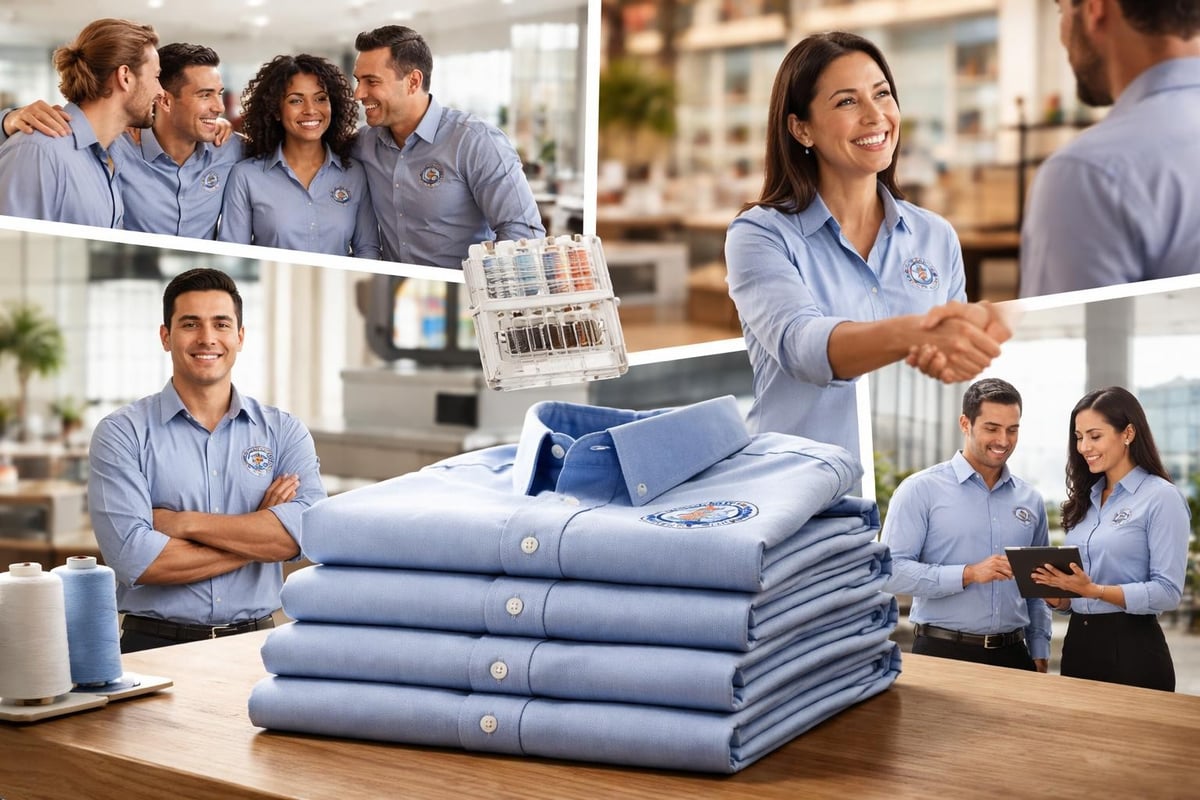
The importance of high-quality workwear extends to employee satisfaction and retention. Providing well-fitted, professionally embroidered shirts demonstrates employer investment in staff presentation and comfort. This investment fosters loyalty and reduces turnover, particularly in competitive employment markets where perks influence job selection.
Security and Identification Advantages
Embroidered shirts serve practical security functions in many environments. Clear identification of authorised personnel reduces unauthorised access risks whilst helping customers quickly locate assistance. Event venues, healthcare facilities, and educational institutions particularly benefit from this immediate visual identification system.
The permanence of embroidery compared to printed alternatives ensures long-term identification reliability. Whilst screen printing may fade or crack over time, quality embroidery maintains appearance through hundreds of wash cycles, providing sustained return on investment.
Maintenance and Longevity Optimisation
Proper care extends the life of mens embroidered work shirts significantly, protecting both garment investment and professional appearance. Washing techniques, drying methods, and storage practices all influence how well embroidered items maintain their quality over time.
Essential Care Guidelines:
- Turn garments inside out before washing to protect embroidery from abrasion
- Use cold or warm water rather than hot to prevent thread degradation
- Avoid chlorine bleach which weakens both fabric and embroidery threads
- Select gentle cycle settings to minimise mechanical stress
- Remove promptly from machines to prevent creasing and colour transfer
The relationship between fabric choice and maintenance requirements affects total cost of ownership. Whilst pure cotton shirts may feel luxurious, they often require ironing to maintain professional appearance. Polycotton blends emerge from washing with minimal wrinkles, reducing labour costs associated with garment preparation. Best practices for caring for embroidered workwear provide detailed guidance for maximising garment lifespan whilst preserving embroidery quality.
Sizing and Fit Considerations
Proper sizing ensures mens embroidered work shirts present professionally whilst providing comfort throughout work shifts. Ill-fitting garments undermine professional appearance regardless of embroidery quality, making accurate sizing essential to overall presentation strategy.
Modern sizing systems accommodate diverse body types through extended size ranges and fit variations. Regular fit provides traditional cut suitable for most body types, whilst slim fit creates contemporary silhouette appealing to younger demographics. Relaxed or classic fits offer additional room for physical work or layering requirements.
Measurement Best Practices
Accurate measurements prevent costly ordering errors and employee dissatisfaction. Chest measurement taken at fullest point determines base size, whilst sleeve length measured from centre back neck to wrist ensures appropriate arm coverage. Neck measurement affects collar comfort, particularly important for buttoned collar styles worn throughout extended shifts.
| Size | Chest (inches) | Sleeve Length (inches) | Neck (inches) |
|---|---|---|---|
| S | 36-38 | 32-33 | 14.5-15 |
| M | 38-40 | 33-34 | 15-15.5 |
| L | 40-42 | 34-35 | 15.5-16 |
| XL | 42-44 | 35-36 | 16-16.5 |
| 2XL | 44-46 | 36-37 | 16.5-17 |
| 3XL | 46-48 | 37-38 | 17-17.5 |
Providing size samples before bulk ordering reduces errors and ensures employee satisfaction. Many businesses order sample shirts in multiple sizes, allowing team members to try options before final selection. This approach particularly benefits organisations with remote employees or multiple locations where in-person fitting proves impractical.
Cost Analysis and Budget Planning
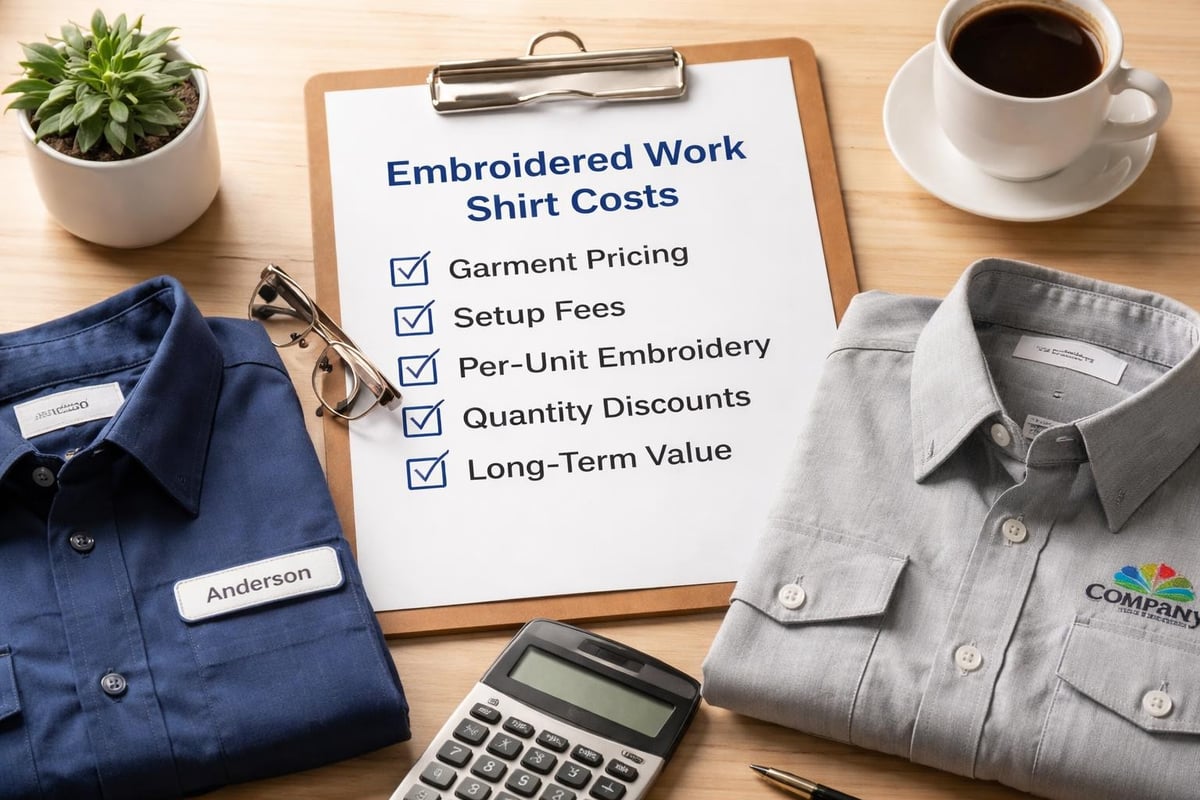
Understanding the complete cost structure of mens embroidered work shirts enables informed budget allocation and realistic expectation setting. Initial garment costs represent only one component of total investment, with embroidery setup, thread costs, and quantity thresholds all affecting final pricing.
Setup fees for embroidery digitisation typically apply to new designs, converting artwork into machine-readable formats. These one-time costs amortise across order quantities, making larger orders more cost-effective per unit. Businesses planning multi-year uniform programmes benefit from this economy of scale, as setup costs don't recur for repeat orders using existing digitised designs.
Stitch count directly influences embroidery costs, with complex designs requiring more time and thread than simple logos. Comparing embroidery versus screen printing reveals how different decoration methods suit varying budget constraints and aesthetic requirements. Embroidery offers superior durability and perceived quality, whilst printing may provide cost advantages for large, simple designs.
Budget Planning Factors:
- Base garment cost varies by fabric quality and construction method
- Embroidery charges typically calculated by stitch count or design complexity
- Setup fees for new designs (usually £15-40 per design)
- Quantity discounts begin typically around 10-20 units
- Rush order premiums for expedited production timelines
Styling Versatility Across Professional Settings
The adaptability of mens embroidered work shirts extends beyond traditional uniform applications. Modern styling approaches demonstrate how these garments transition between formal business environments and casual professional settings, maximising wardrobe investment.
Short-sleeve options suit warmer climates and physically active roles, whilst long-sleeve versions provide year-round versatility and additional branding space. Button-down collars create smart-casual appearance appropriate for client-facing roles without excessive formality. Point collars maintain traditional professional appearance suited to corporate environments and formal service industries.
Combining embroidered work shirts with complementary workwear creates cohesive professional appearance. Pairing with branded polo shirts for layering options gives teams flexibility across seasons whilst maintaining consistent brand presentation. This versatility proves particularly valuable for businesses operating across varied environments or seasons.
Supplier Selection and Quality Assurance
Choosing reliable suppliers for mens embroidered work shirts requires evaluation beyond simple price comparison. Production capacity, turnaround times, quality consistency, and customer service all impact overall satisfaction with uniform programmes.
In-house embroidery capabilities offer significant advantages over outsourced decoration. Businesses benefit from faster turnaround times, better quality control, and easier communication when suppliers handle embroidery internally rather than subcontracting. Why in-house embroidery matters explains how integrated production improves outcomes whilst reducing complications.
Quality Verification Checklist
Establishing quality standards prevents disappointment and ensures consistent results across orders. Sample approval before bulk production allows businesses to verify thread colours, logo placement, and overall appearance match expectations. This verification step proves particularly important for first-time orders or when switching suppliers.
Thread quality affects both appearance and durability. Premium polyester or rayon threads maintain colour vibrancy through repeated laundering, whilst inferior threads may fade or fray prematurely. Backing materials used during embroidery process influence how well designs maintain shape without puckering fabric.
Supplier Evaluation Criteria:
- Minimum order quantities that align with business needs
- Production lead times from order confirmation to delivery
- Sample provision policies and associated costs
- Returns and remake policies for defective items
- Communication responsiveness and technical support availability
- Portfolio of previous work demonstrating capability with similar projects
Environmental Considerations and Sustainability
Growing environmental awareness influences purchasing decisions across all business sectors, including workwear procurement. Sustainable fabric choices, ethical production methods, and garment longevity all contribute to reduced environmental impact whilst aligning with corporate responsibility objectives.
Organic cotton options provide environmentally conscious alternative to conventional fabrics, eliminating pesticide use during cultivation. Recycled polyester manufactured from post-consumer plastic bottles diverts waste from landfills whilst creating durable, performance-oriented fabrics. Eco-friendly embroidered workwear options demonstrate how sustainability integrates with professional presentation requirements.
The durability inherent in quality embroidered work shirts supports sustainability through extended garment life. Replacing uniforms less frequently reduces manufacturing demand and associated environmental impacts. This longevity, combined with classic styling that resists fashion trends, creates genuinely sustainable workwear programmes.
Circular Economy Approaches
Progressive businesses implement take-back programmes for worn uniforms, ensuring responsible disposal or recycling rather than landfill destination. Some manufacturers offer recycling services that convert old garments into new fibres, creating closed-loop systems that minimise waste. These initiatives particularly appeal to environmentally conscious customers who value corporate responsibility.
Brand Enhancement Through Strategic Implementation
Maximising the branding potential of mens embroidered work shirts requires strategic thinking beyond simple logo application. How to add logos that enhance your brand explores positioning, sizing, and design elements that transform workwear into effective marketing assets.
Consistency across all branded touchpoints strengthens brand recognition and professional perception. Embroidery colours should match established brand guidelines, maintaining visual coherence with business cards, signage, and digital presence. This consistency creates subconscious familiarity that builds trust through repeated exposure.
Employee names embroidered alongside company logos personalise customer interactions whilst enhancing accountability. This personal touch particularly benefits service industries where relationship building drives customer loyalty. Position titles or department identifications further enhance professional presentation whilst helping customers identify appropriate contacts for specific needs.
Strategic Branding Elements:
- Logo prominence balanced against professional discretion creates optimal impact
- Tagline incorporation reinforces brand messaging when space permits
- Website or contact details on reverse side facilitates customer follow-up
- Colour-coded departments aid internal organisation and customer navigation
- Anniversary or achievement recognition through special embroidery marks milestones
Innovation and Future Developments
The workwear industry continues evolving with technological advances and changing workplace expectations. Smart fabric integration, antimicrobial treatments, and enhanced performance characteristics represent emerging trends influencing mens embroidered work shirts development.
Moisture-wicking technologies initially developed for athletic wear now appear in professional workwear, improving comfort for physically demanding roles. UV protection treatments benefit outdoor workers, whilst stain-resistant finishes maintain professional appearance despite challenging work environments. These functional enhancements complement traditional embroidery, creating garments that perform as impressively as they present.
Digital embroidery technology enables increasingly complex designs with photographic detail previously impossible. Three-dimensional puff embroidery creates raised effects that add visual interest and tactile dimension to logos. Metallic threads introduce subtle shimmer appropriate for upscale hospitality and retail environments without appearing ostentatious.
The integration of personal protective equipment standards with professional appearance requirements drives innovation in specialised sectors. Flame-resistant fabrics with embroidery capabilities serve petrochemical industries, whilst high-visibility materials accommodate safety embroidery for construction and logistics applications. Understanding industry-specific embroidery approaches helps businesses navigate these specialised requirements.
Mens embroidered work shirts represent significant investment in professional image and team unity, delivering measurable returns through enhanced brand recognition and customer trust. Selecting appropriate fabrics, implementing thoughtful design strategies, and partnering with capable suppliers ensures maximum value from uniform programmes. Whether your business operates in construction, hospitality, healthcare, or corporate services, Cobra Workwear provides comprehensive embroidered workwear solutions with in-house production capabilities that guarantee quality and fast turnaround times tailored to your specific industry needs.
